Exciting New Anime: Knights of Sidonia

Media

Knights of Sidonia lifeboat pod

No matter how much I like an anime series, I hesitate to make blanket recommendations. I’d hate for my writing to entice someone to watch anime for the first time and have them come away thinking I have terrible taste in TV. See, there’s a learning curve to watching anime. (The giant anime sweat drop? It means he’s embarrassed.) Without “anime literacy” an anime newbie can watch even the best series and think it’s silly, or worse, a product for children. Knights of Sidonia is definitely not for children.

Also, even the best anime suffers from radical swings in quality over the course of a long season. Think of Joss Whedon TV shows—Buffy, Dollhouse, Firefly. We love them for their high highs, despite the admittedly horrid lows.

That said, Knights of Sidonia (KOS), a recent Netflix Original Series, is some of the most thrilling military science fiction I’ve seen in a long time. It’s certainly not without its shortcomings. Its relationship drama doesn’t succeed the way the military aspect does; the several love-triangles and the central rivalry between the hero and his nemesis are so thinly drawn as to feel tacked on. Yet the stunning battle scenes–the eye-popping visions of sci-fi adventure futurism–make the series more than worth one’s while.

Although I don’t have time to review KOS in full, here, I’ll drop a few observations.

1) How to Repopulate the Human Race

The show’s renderings of deep-space survival create an intriguingly realized future. Sidonia is a “seed ship.” It’s a Battlestar Galactica setup. When the earth was overrun by aliens, the last survivors escaped on Sidonia and survived seven centuries drifting about the galaxy. How did the seed ship repopulate the human race? Successful cloning explains all the look-alike characters in the cast. Others form a “third gender,” changing sexes depending on available partners. Apparently there are limits to seeding “success”: Sidonia holds regular mass funerals for compulsory deaths to keep its fragile ecosystem in check. An “organic converter reactor” processes all the bodies and human excrement for fuel that powers Sidonia.

2) Hillarious Site Gags

KOS re-imagines space travel in (ahem) compelling detail, like the skin-suit catheter (see image). Not only is the catheter necessary for spending many hours (or even days) in the tiny cockpit of a giant robot, the skin suit also filters urine for drinking water.

In one quiet scene our hero averts his gaze to leave his co-pilot her privacy while she photosynthesizes. (Yes, in the future we will only eat once a week because, via genetic modification, we will all photosynthesize.) But because they’re in the glass-bubble cockpit, he can’t escape her nude reflection. Hence, he doubles over in discomfort at the emergence of his catheterized erection!

3) Space Opera!

The space opera (i.e., soap opera in space) elements are by turns wonderful and awful. In quieter moments, the romance between the hero and his love interest can be quite affecting, like when the two are stranded in deep space together, trying not to freak out in the face of dwindling food and water rations.

Sadly, the show’s fan service tends towards the sleazy: untold millions were spent to animate the zero-gravity jiggling of curvy female figures in skin-tight space suits.

4) Warning:  It Goes Fast

That the script doesn’t wait for slower viewers can be a bit frustrating at times. Like any good cyberpunk fiction, KOS respects the intelligence of its audience, rarely overexplaining its backstory and future-tech. The show assumes fans will take multiple passes by hitting rewind or will binge-watch the whole season again later, anyway.

For instance, there appears to be a blunder of failed script-supervisor continuity when we watch a pilot eject from her exploding robot in only her space suit. But in the next scene we see her floating in a spherical, escape-pod lifeboat (see image at very top of this post).

Where’d that come from? Turns out the escape pod is stored in each pilot’s backpack, in some futuristic wonder of nanotechnology. Very cool. I definitely missed it the first time around.

KOS escape pod A-0

KOS escape pod A

KOS escape pod B

KOS escape pod C

5) The Good with the Bad

It’s a shame the first half of Episode 5 gives us one of the most exciting battle scenes ever filmed, a thrill negated by the episode’s second half: an overlong, ham-fisted delivery of backstory, all in unnecessary and terribly written dialogue. When Captain Kobayashi argues with Dorm Mother Lala, she reminds her of a factoid neither could have possibly forgotten: “We’re the last two surviving members of the first strike team in human history to have destroyed a gauna, 600 years ago.” Ugh.

I guess it’s no worse than Rick Grimes in The Walking Dead talking out loud to God, the empty chapel amplifying his cartoonish Southern accent.

6) Coincidence or Cosmic Convergence?

Though spelled differently, the series shares its title with the Muse album “Knights of Cydonia.” Coincidence or cosmic convergence? Judge for yourself by watching the hilarious, sci-fi/kung-fu/spaghetti Western mashup video of Muse’s song on YouTube:

Commuter Bikes and the Trek Soho Deluxe

Health

trek soho deluxe

My friend Tony asked if I’d have a look at this bike.  Tony lives in DC and commutes by bike, escorting his wonderful daughter to school every morning, all by DC bike share.  He’s become a bike-share-system savant — the hackles on his neck rise the closer he gets to the thirty-minute bike-share quota.  But his daughter is graduating to middle school this year, where there isn’t a convenient bike-share station to switch bikes.

So Tony needs to buy a new bike.  His commuting needs neatly mark out the boundaries of the no-maintenance bicycle market — namely, internal gear hubs (IGH) and carbon belt-drives.  So it’s no surprise he’s put his finger on the Trek Soho Deluxe.

In researching this bike, I’ve done my usual eval, all the while not realizing the model has been discontinued.  So I’ve also done a quick and dirty search for “city bike,” “belt drive,” and “disc brakes.”  That’s turned up a decent list of some drool-worthy machines for 2014-15.

My evaluation of the discontinued Soho Deluxe is still relevant, though.  Not only are the components of bikes in this narrow market segment very similar.  There are probably a number of Soho Deluxe’s still in showrooms in every major city, and at closeout prices, to boot.  So I’ll just include that here, while adding the list of current-model bikes at the end.

MISC. NOTES Re. the TREK SOHO DELUXE

1) If you find a “new” model, it’ll likely be a great deal, with “closeout” pricing.  (The model was discontinued for 2014.)  But what year is the specimen you’ve found, 2012 or 2013?

Consider the following:

a) Normally a year or two sitting in a showroom makes no difference.  But with internal gearing, lubrication can leak out or settle in ways detrimental to the parts.  So if you find a 2012 Soho Deluxe, ask if the bike shop will re-lube the hub upon purchase.  Sheldon Brown discusses lubrication issues, here:  http://sheldonbrown.com/nexus-mech.html

b) Internal gearing has come a long way in recent years, and the different iterations of the Nexus 8-spd. hub are no exception.  I don’t have the specifics on whether or not the 2013 is significantly better than the 2012.  Might be something to research further.

c) Similarly, the newer Gates belt drives are reported to be much better than older versions.  I’m not sure what the timeline is, so that’s something to look into, as well.

2) No quick release rear wheel.

a) Much more difficult to change a flat on the fly.  Here’s a somewhat daunting tutorial.   https://www.youtube.com/watch?v=HCREx_q55mw

b) I’d recommend upgrading to a flat-resistant tire, at least on the rear.  (May as well do both.)  Ask dealer for if you can trade out the tires for some credit towards the purchase.  Kevlar is good (though more expensive).   I haven’t had a flat on Kevlar tires in 4 years, riding 300 days/year.

3) Test drive it:  how’s the lowest gear on your local terrain?

a) Find a decently steep hill.  My wife rides internal gearing, the Shimano Alfine 8-speed hub, and here on the modest yet significant hills of Madison, Wisconsin, her lowest gear is perfectly doable.

b) Note:  one mustn’t shift internal gearing under load.  That’s something the LBS might forget to tell you.  This is certainly not a deal-breaker.  It just takes some dexterity to let up the force when shifting.  Definitely don’t want to stand up pedaling when shifting an IGH.  Some user reviews claim the NuVinci N360 hub is the exception to this rule.  (See the Novara Gotham, below.)

4) Misc. questions:  Rack mounts, front and rear?

One reviewer called the Soho Deluxe a “thief magnet” because it has a “flashy appearance.”  I think it’s the opposite.  It’s got a low-key, even stealthy, paint job.  Plus, theoretically, it may be even less likely to be stolen, for the fact of the belt-drive.  Rational bike thieves avoid specialty bikes because pawn shops may balk at buying such easily identifiable items.

COMMUTER-BIKE ALTERNATIVES for 2014-15

The market for low-maintenance commuter bikes (belt drive, internal gearing) seems to be shrinking in the middle ($1000 – $1400), while growing at the lower end ($600-900) and higher end ($1500 – $2500).  Back in 2012-13 there were many more models in the middle price range.  I had to really hunt for these:

Raleigh Misceo 4.0 2013

Great closeout deals

— Alfine hub (an upgrade over the Nexus hub of the Soho Deluxe)

$1100 closeout

http://www.rei.com/product/848626/raleigh-misceo-trail-i11-bike-2013

Raleigh City Sport DLX

$1100

http://www.bicycling.com/gearfinderProductDetail?gfid=78254

Breezer Beltway 8

$1500

http://www.bicycling.com/bikes-gear/bikes-and-gear-features/best-urban-bike-breezer-beltway-infinity

Novara Gotham

$1400

http://www.rei.com/product/857590/novara-gotham-bike-2014

— NuVinci N360 hub

Scott SUB 10

$1300

http://www.rei.com/product/865741/scott-sub-speed-10-bike-2014

Focus Planet 2.0

$1400 (not widely avail. in US)

http://www.paragonsports.com/shop/en/Paragon/focus-bicycles-usa–inc-belt-drive

Beer Roundup #10: Three Coffee Stouts

Food and Drink

Lagunitas Cappucino Stout coffee beer

To Buy or Not to Buy?

1 = horrible
2 = bad
3 = average
3.5 = good (many better beers out there; won’t buy this again)
4 = very good
4.5 = great
5 = rare best


A Note on the Style:  Coffee Stout

Coffee Stout is actually not a style you find described in the BJCP (Beer Judge Certification Program).  A coffee stout is essentially an American stout in which the brewer has added coffee beans or grounds to the boiling wort.  The result is generally a beer of middling alcohol content (say, 5% – 7% ABV), low to middling hop bitterness (30 – 60 IBU), and a pronounced roasted coffee flavor.

Cappuccino Stout, Lagunitas Brewing Co.
Rating:  4.2 / 5
22 oz. bottle, 9.2% ABV, 82 IBU.

This is a double stout, by the way.  The other two beers in this roundup are regular stouts.

A nice looking pour from a bomber into a tulip glass. Somewhat thin-looking, black, to be sure, with a smallish head, and very sticky lacing.

Perhaps this bottle hasn’t benefited from sitting in my cellar for five months. The coffee aroma seems muted.  A lactose smoothness in the nose makes the coffee-and-cream character astonishingly accurate.  (Pretty sure this was not brewed with any lactose, though, so technically it’s not a “sweet stout” or “milk stout.”)  There’s some vanilla, biscuit, unsweetened cocoa, and a grassy bitterness that must be hops.

Coffee flavor in the mouth is highly bitter, a mouth-puckering acid disrupted some by a milky sweetness that renders the burnt flavor a semisweet chocolate. The vanilla comes forward, with lots of dark chocolate and a subtle buttery caramel. Finish dries out a bit . . . No. Scratch that. The finish is pretty dang sweet. Yes, it’s black coffee and sugar.

If not for being a bit watery in body, the lactose-seeming creaminess makes the “capuccino” element awesomely spot-on.

I used to be in love with this beer. I’m wondering, it should be noted, if five months sitting has hurt this beer. I’ll have to wait ’til next year to see if a fresh specimen recaptures that old magic.

Jingle Java, Bent River Brewing Co.
Rating:  4.55 / 5
12-oz. bottle, 6.5% ABV, 29 IBU.

How lucky to have found this winter holiday beer still lingering in the singles cooler of my neighborhood bottle shop.  It’s fabulous.

This is the most stunning coffee flavor I’ve ever had in a beer. It really is an iced-Americano, with carbonation. The aroma is pure cold coffee with milk.

Flavor in the mouth is uncannily straight-up fresh-brewed iced coffee. There’s a tart, tinny hop bitterness that tries to remind one this is beer. But the aggressive French-roast flavor resists such a notion. There’s a nice sweet vanilla in the background that helps a milk chocolate undercurrent emerge from the dark depths.

Best coffee stout I’ve ever had. Blows doors on New Glarus Coffee Stout. While there are better coffee-infused stouts of imperial strength (Central Waters Brewhouse, 8.2%; Southern Tier Mokah, 10%), Jingle Java beats anything in the 6% – 7% alcohol range.

I wonder how much the low bitterness (29 IBU) plays a part in this brew’s success?

Java Lava, Pearl Street Brewing Company
Rating:  3.9 / 5
12 oz. bottle, 6.0% ABV, ? IBU

Wow, a third really good coffee stout in one night. USA! USA!

Earlier I had Jingle Java, by Bent River, out of Rock Island, Illinois. I’ve heard Bent River has an amazing imperial stout festival. The Jingle Java was actually a cut above this one, but this is still rather decent.

It’s not over the top amazing, like the Jingle Java. But this beer has an excellent demitasse essence.   Great creamy mouthfeel, despite the high carbonation.

Hmm.  As the level in my glass recedes, I see it’s actually nowhere near as good as the Jingle Java.  But it’s a solid brew.

New Panniers Even Better Than I Thought

Health

IMG_3532


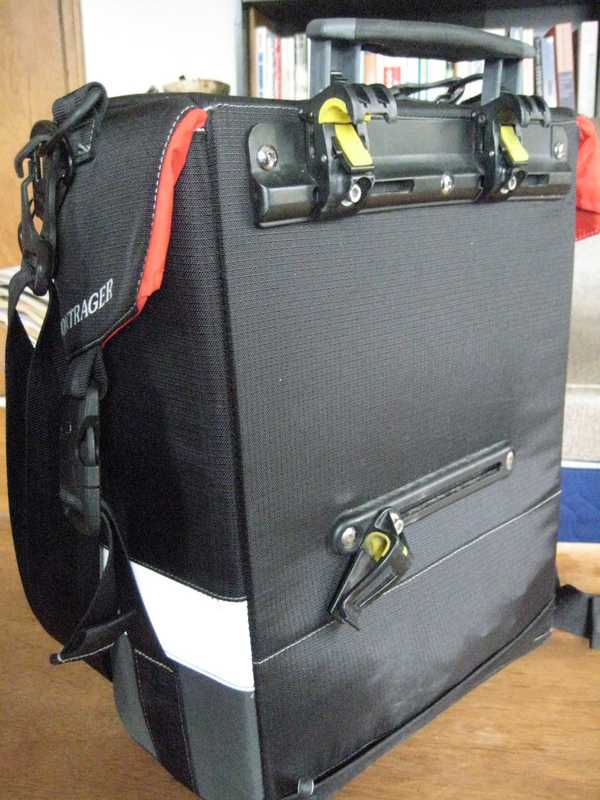
I’ve actually been using this pair of panniers for almost a year.  I got caught in a downpour last night, which was fine since the bags are waterproof to their interior volumes.  However, the zippers are not water resistant.  The zippered pockets can get pretty damp in heavy rain.  So I’ve never kept anything water sensitive in the pockets.

Until now.

Last night after that torrent of rain, I discovered a hidden feature of the bags:  each bag has a rain “poncho” to cover itself when needed.

2-IMG_3533See that bulge towards the bottom?  That’s the poncho tucked away in a zipper pocket of its own.

3-IMG_3534Not only does the poncho keep the zippered pockets dry.  It also keeps the outer fabric of the bag from getting soaked.

4-IMG_3535

5-IMG_3536These bags are the Bontrager Interchange Urban Commuter Panniers. They’re sold as a set of two, $179. (Bontrager has been one of Trek’s component & accessory divisions since 1995.)   Each bag contains the volume of a paper grocery sack.   http://store.trekbikes.com/product/bontrager+interchange+urban+commuter+pannier.do

Beer Roundup #9: Three Double IPA’s

Food and Drink

Hop Juice

To Buy or Not to Buy?

1 = horrible
2 = bad
3 = average
3.5 = good (many better beers out there; won’t buy this again)
4 = very good
4.5 = great
5 = rare best

A Note on the Style:  Double IPA, Imperial IPA

Imperial IPA, a.k.a. Double IPA.  A friend of mine recently asked about the terminology.  Rather than referring to an increase of ingredients or the number of fermentation stages, “double IPA” is a nickname for “imperial IPA” (from the acronym “IIPA”).

Hop Juice, Left Coast Brewing Co.
Rating:  4.14 / 5
12 oz. bottle (4-pk), 9.7% abv, 82 IBU.

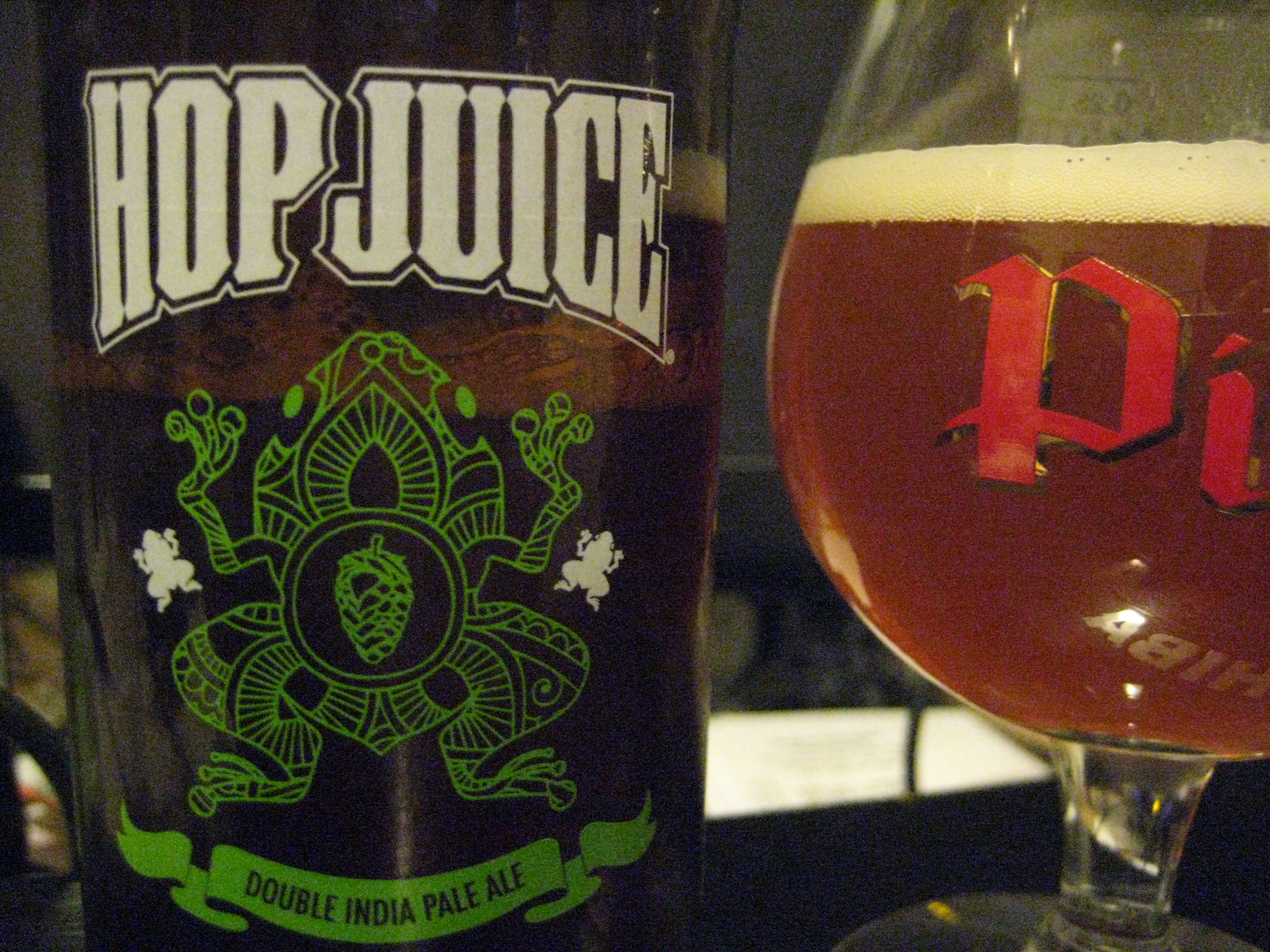
From a bottle into a tulip, it pours a hazy amber, with very little head, but prodigious lacing.

Remarkably reserved, semisweet aroma. A pleasing herbal and earthy hop aroma. Some barely perceptible Wonder bread in the background, though one must strain to detect the mere whiff of grain.

In the mouth it’s an interesting sub-piney bitterness.  No, wait, I’ve got it:  it’s cold sake!  Very bitter on the backend.  Balance comes from a neutral (not sweet) maltiness. No, scratch that.  As it warms, there’s a serious candy sugar sweetness. Deep hop flavors dominate, spurred on by a sharp alcohol twang.

Medium-bodied, almost chewy. Well-carbonated, with a slippery alcohol warmth.

A very good double IPA, though not as malty as I like them. It supplies a nice sweetness, but it’s missing something. Can’t quite put my finger on it. Nevertheless, I think I’ll be buying one more 4-pack (though none for the cellar).

Palate Wrecker, Left Coast Brewing Co.
Rating:  4.18/5
12-oz. bottle (4-pk), 9.5% abv, 100+ IBU.

Wow, what a great smelling beer.  Its claim to fame is its aggressive hop bitterness.  But the sweet aroma is my favorite feature of this brew.

It’s an awfully handsome, clear golden pour into a tulip, with a big cottony head that sticks around.

The aroma really distinguishes this brew. Sweet, juicy fruits galore: red grapefruit, pineapple, and finally sweet tangerine. Perhaps a honey/floral tea character.

In the mouth, the early sweetness is all fruit juice. Yum.  The hops come on as a salty, white grapefruit bitterness. There’s almost no malt sweetness; the sweetness is fruit, only. Not candied fruit, just ripe, juicy, sweet citrus. Once it’s down the gullet, the aftertaste turns sharply bitter, as if smearing the the throat with white grapefruit rind. That hurts this beer.

Great medium-bodied richness. The high carbonation is a welcome cleanser.

Heelch O’Hops, Anderson Valley Brewing Company
Rating:  3.95 / 5
12 oz. bottle (4-pk), 8.7% abv, 100 IBU

This brew was featured in a Draft Magazine article that had everyone talking, “Three Imperial IPA’s That Rival Heady, Pliny.”  The title truncates the full names of the two beers roundly considered among the best double IPA’s, “Heady Topper” and “Pliny the Elder.”  Those two are also among the most difficult to find beers in the US.,  which is why people are always looking for close substitutes.

Heelch O’Hops ought not to have been included in that article.  (The other two beers featured:  Doozy by Mother’s Brewing and Hopothermia by Alaskan Brewing.)  Heelch O’Hops is certainly not bad.  It’s just not anywhere near the vicinity of elite class brews.

It pours a finger of white head atop a thin, clear, yellow liquid. The foam leaves lacing stuck hard.

A disappointingly subdued, peppery aroma of shy hops. No detectable malt presence in the nose.

The flavor is also disappointing in the mouth. Where’s the malt, the sweet, or the bread that I want in a IIPA? The hop character gives grapefruit pith, rather than sweet orange or tropical fruit. An astringent pine on the back end forces one to take this brew seriously.  It’s that bitter.   Finishes bitter-dry.

Thin body, with moderate to high carbonation.

A quality brew, to be sure, but disappointing that it’s merely an IPA on steroids:  it’s got none of the malt balance or bigger body or sweet fruit of the double IPA’s I love, such as Hopslam, Chillwave, Hi Res, or Double Crooked Tree. Especially disappointing at $12.00 / 4-pack.

Easton Bell Sports: Now That’s Customer Service

Entrepreneurship, Health

Easton Bell $0.00 highlighted

Just wanted to send out some well-deserved praise for a company with excellent customer service.

Last December I damaged my Giro snowboard helmet.  I bent the metal snap of the goggle strap on the rear of the helmet.  (I mean the strap at the rear that clamps down over the strap of ski goggles).  After unsnapping the strap to remove my goggles, I found I could no longer close the snap.

I use this snowboard helmet for winter cycling.  As I don’t have a car, I need it on a daily basis.  This was an especially cold winter here in Madison.  I generally switch from wraparound glasses to ski goggles below 15°F.  While I don’t use goggles everyday, this is Wisconsin!

So, I emailed Giro, asking where I could buy the replacement parts.  I wasn’t optimistic.  In this age of disposable products and terrible customer service (I’m looking at you, AT&T, major airlines, Chase Bank, etc.), I half-expected to be told there are no replacement parts, if I were to be answered, at all.

They actually got back to me the very next day.  It was Customer Service Rep Amber Thomas, from Easton-Bell Sports, the parent company of Giro.  She said she would put the replacement strap in the mail, and I should receive it by the end of the week.  Sure enough, the strap arrived two days later.  I was thrilled to be able to use my goggles the rest of the season, without having to buy a brand new helmet.

(For those of you who say you don’t need the helmet strap to use goggles:  while running errands around town on my bike, I’m constantly removing my goggles and putting them back on.  This is much, much simpler to do with your helmet’s goggle strap latched to your goggles, as if the goggles were an integrated part of your helmet.)

When I wrote Amber back expressing my gratitude, she replied, “We just want you to have a fully functioning helmet.”

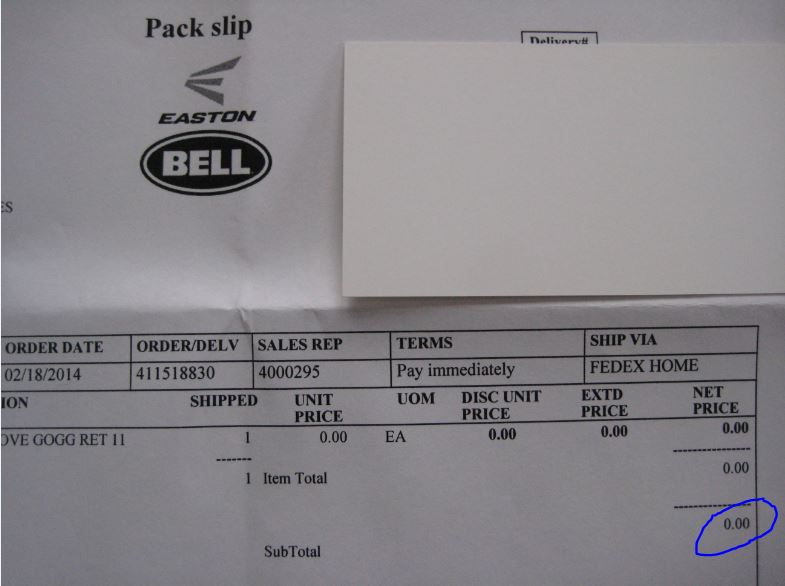
What you’re looking at in the image above is the packing list that arrived with the replacement parts.  Notice the figures listed in the “price” columns.  That’s right, “$0.00”

But, wait.  There’s more.

Several years back, I had a great little micro-light for the top of my skating helmet.  This was back in Houston, where the heat and humidity made Rollerblading at night the natural choice.  You need a light to skate at night, obviously.  Some of you may know this micro-light I’m referring to, called The Flea, by Blackburn.  They still make the Flea, but back then the Flea charged off of any battery via a little charging device.  My charger had a wire break loose.  I emailed Blackburn about it.  Same as with my helmet, Easton-Bell Sports, the parent company of Blackburn, sent me a replacement charger at no cost.

We’re talking a company with nearly $1 billion in annual revenue.  So how do they succeed while giving away equipment at no charge?  By making lifelong customers like me.  That’s how.

Just FYI, after selling one of its several manufacturing divisions, the company has recently rebranded itself as BRG Sports.

Beer Roundup #8: Three American Barleywines

Food and Drink

Old Horizontal - Victory

To Buy or Not to Buy?

1 = horrible
2 = bad
3 = average
3.5 = good (many better beers out there; won’t buy this again)
4 = very good
4.5 = great
5 = rare best


A Note on the Style:  American Barleywine

(This style note is essentially the same as the one from my post “Beer Roundup #7:  Three Midwest English Barleywines.”)

American breweries produce both types of barleywine, the malty “English” style and the hoppy “American” style.  As I’m more of a malt guy, I prefer the sweeter English style.  The hoppy American style comes with hop bitterness to rival even the most mouth-puckering IPA.    All barleywines have a stiff malt backbone and generous sweetness, but the hop-forward American-style is often so bitter as to be indistinguishable from a high-alcohol double IPA.  Don’t get me wrong, some of my best friends are double IPA’s; I love me a double IPA when it’s got intense sweetness to offset the high IBU, like Bell’s Hopslam, Dogfish Head 120 Minute, or Dark Horse Double Crooked Tree.  Same with American barleywines:  as long as it’s both bitter and sweet, it’s got my attention.

Bigfoot, Sierra Nevada Brewing Co.
Rating:  4.39 / 5
12 oz. bottle (4-pk), 10.2% abv, 73 IBU.

A glinting copper pour into a tulip glass, with an inch of off-white fluffy head that plasters lace on the glass.

The syrupy viscous feel in the mouth is too wonderful not to mention first. The first sip comes with a short-lived sugar sweetness. Then bitter grapefruit renders the sugar a memory. The citrus morphs to tarry pine. Whoa, this brew is too bitter. I immediately want to throw this in the cellar to teach it some manners.  That said, there is a secondary sweetness that calls out from the bitter abyss, alluding to a caramel malt sweetness that’s promised with a year or two of cellar aging. But the spicy alcohol heat teams up with the bitter hops to silence such rumors.

Stepping back to take in the aroma, a pungent honey and ripe melon seem to confirm the ghost of the sweetness. As the glass warms, the bloated bitterness deflates a bit, and a moist, grainy bread emerges, allowing that original simple syrup sugar to creep back into the room.

Rough-edged and impressively huge, like Greenflash Barleywine, this brew lacks the balance and polish of my favorite American barley wines:  Bell’s Third Coast Old Ale and Alaskan Barley Wine.

Beer Line, Lakefront Brewery
Rating:  3.96/5
12-oz. bottle (4-pk), 12.5% abv, 52 IBU.

Sticky, two-finger creamy head and lacing. Rouge-brown amber fluid.

My least favorite beer aroma hits the nose first:  leather. Milky rice pudding and wonder bread make up the malt bill. Brown sugar and vanilla, plus a mild booziness.  Very little hop bitterness in the aroma.

In the mouth the leather greets the palate, first, unfortunately. There’s a waterlogged driftwood that seems wedded to a chocolate-toffee sweetness and a nice estery burn.  Finishes with a loamy top-soil earthiness and a floral bitterness.

Medium- to full-bodied. Creamy and slick, a sticky, bitter finish.

This afternoon I was overly impulsive, buying two 4-packs of this brew.  Perhaps my judgment was clouded by the joyous memory of two recent Midwest barleywine discoveries:  1) just last month I cellared three four-packs of the enviable Stevens Point Whole Hog Barleywine (Wisconsin); and, 2) last month I was floored by Schell’s Stag Series BW (Minnesota), on tap at Mason Lounge.  Those two are a cut above this Beer Line barleywine (Wisconsin).  I don’t think I’ll be buying anymore of this one.  (Going by my ratings system, 4.0 is the cutoff point for purchasing any beer again.

Still, this is a fairly delicious barleywine, more English-style than American. I’ll throw the remaining seven bottles in the cellar.  Maybe a year might do good things, especially with the 12.5% ABV.

Old Horizontal, Victory Brewing Company
Rating:  4.41 / 5
22-oz. bottle, 11% abv, [85] IBU (estim.)

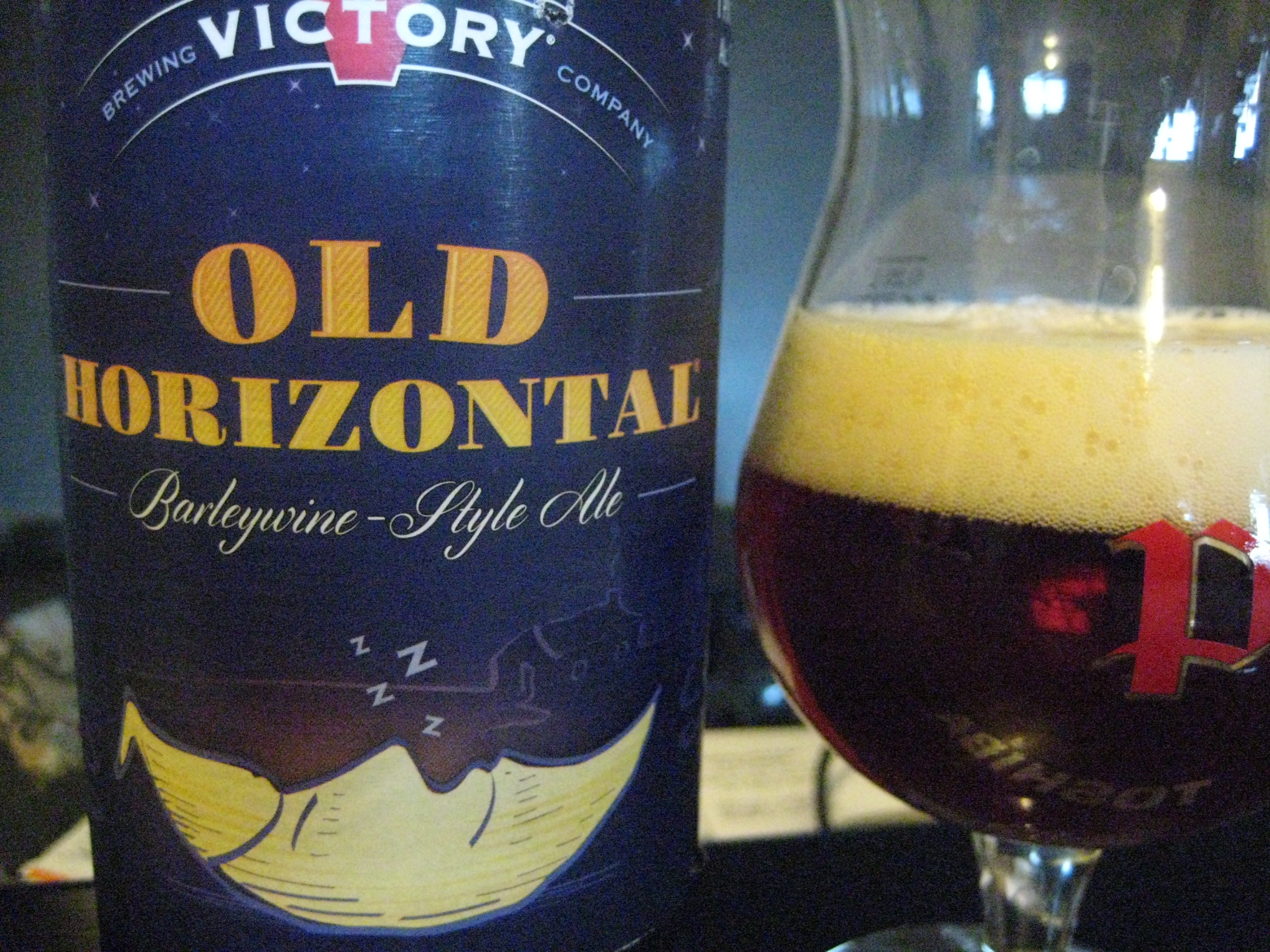
A bomber poured into a tulip glass creates a seriously handsome, ruddy copper glass of beer. It’s topped by a finger of fluffy off-white head that stays and stays, with sticky lacing.

Hoppy aroma, though quietly so.  An indeterminate spiciness.  Sweet grain. The alcohol is present.

Flavor in the mouth opens with sweet bread and red wine, plus a spicy alcohol.  Becomes instantly bitter from the citrusy hops, which dominate through the middle palate and onward through the finish. The sweetness rings as an echo on the backend, though sweetness here is refracted by the intense, white-grapefruit bitterness.

A medium- to full-bodied, luxurious mouthfeel, with a lively carbonation.

Classic American barley wine, very much like Bigfoot, though even bigger (except for the aroma). Intensely hoppy and spicy. The one drawback might be the near eclipse of malt sweetness by the tannic wine and citric bitterness. Nothing a bit of cellaring won’t cure.

Beautiful New Business Cardholders

Entrepreneurship

IMG_3297

IMG_3301


For all the mind-numbing busywork of starting a new business, certain tasks come with real  emotional rewards.  That’s certainly the case in choosing this new business card holder.  Like practically every other piece of start-up research, this one took time and shoe leather.  After visiting four physical shops and nearly two dozen Etsy stores, I finally settled on this handsome handcrafted wooden piece.

What clinched it for me was the manufacturer, Inelastic Goods, is a one-man operation based right here in Madison.  Steve, the creator of the line, delivered the item himself, eager to show me six or seven different models.  I jumped at the chance to buy two additional cardholders at a discount.

I’m keeping the white oak for myself and have bought two of the darker wenge wood models for gifts.  The wenge wood model is striking in the contrast of two dark planes sandwiching a lighter maple side piece.  The white oak does the opposite, playing up the continuous grain and color, as if the box were carved from a single block of wood.

IMG_3308

IMG_3307


All models come with a magnetic closure that clicks shut oh so satisfyingly.  I catch myself playing with it constantly.  Plus, beyond the visual delight of the hand-finished hardwoods, Steve’s execution of the clean, minimalist design is unparalleled.  Each piece feels stunningly smooth in the hand, the joinery, edges, and curves so silky and organic.

By day, Steve works as an engineer for the state of Wisconsin.  On his own time he exercises his entrepreneurial spirit, refining his craft, streamlining his processes and tools, with the aim of not only perfecting the product, but boosting productivity.  His woodshop has become so efficient, he’s recently made good on a private order of sixty business cardholders to a private individual.

Head over to Steve’s Etsy shop for a look at the different models:

https://www.etsy.com/shop/InelasticGoods?ref=l2-shopheader-name

A Quality Color Laser Printer + Great Customer Service = Dell C1760nw

Entrepreneurship, Media

for blog - color printer review

Ah, researching office equipment–one of my favorite pastimes.  (Not!)  I took my time with this one, going back and forth with my decision tree (for instance, shifting my budget from $200 to $600, and back again).  I ultimately ordered from Staples.com, so I could return any lemon locally.  That’s a sign of me bracing against all the ways a purchase like this can go wrong.

I’m happy to report my good fortune:  not only do I have my new color printer up and running, but I found Dell customer support highly competent and remarkably responsive.

After setting up the printer, my initial test run appeared problematic:  underscore was showing more like strike-through.  Contacting Dell tech support through live-chat was instantaneous:  Niegel, the support analyst, came online the very moment I opened the chat dialogue.  Niegel was great.  His troubleshooting helped me isolate the problem to a specific application; the underscore issue only appeared when printing from Evernote.  Yay!  I wouldn’t have to return the printer, after all.

After closing the live chat module, I received an email from Niegel offering his direct contact info in case I had further questions.  He even included the contact info of his supervisor.  Now that’s transparency!  To top it off, the following day, Niegel followed up with another email, offering further assistance if I had come up with other questions.

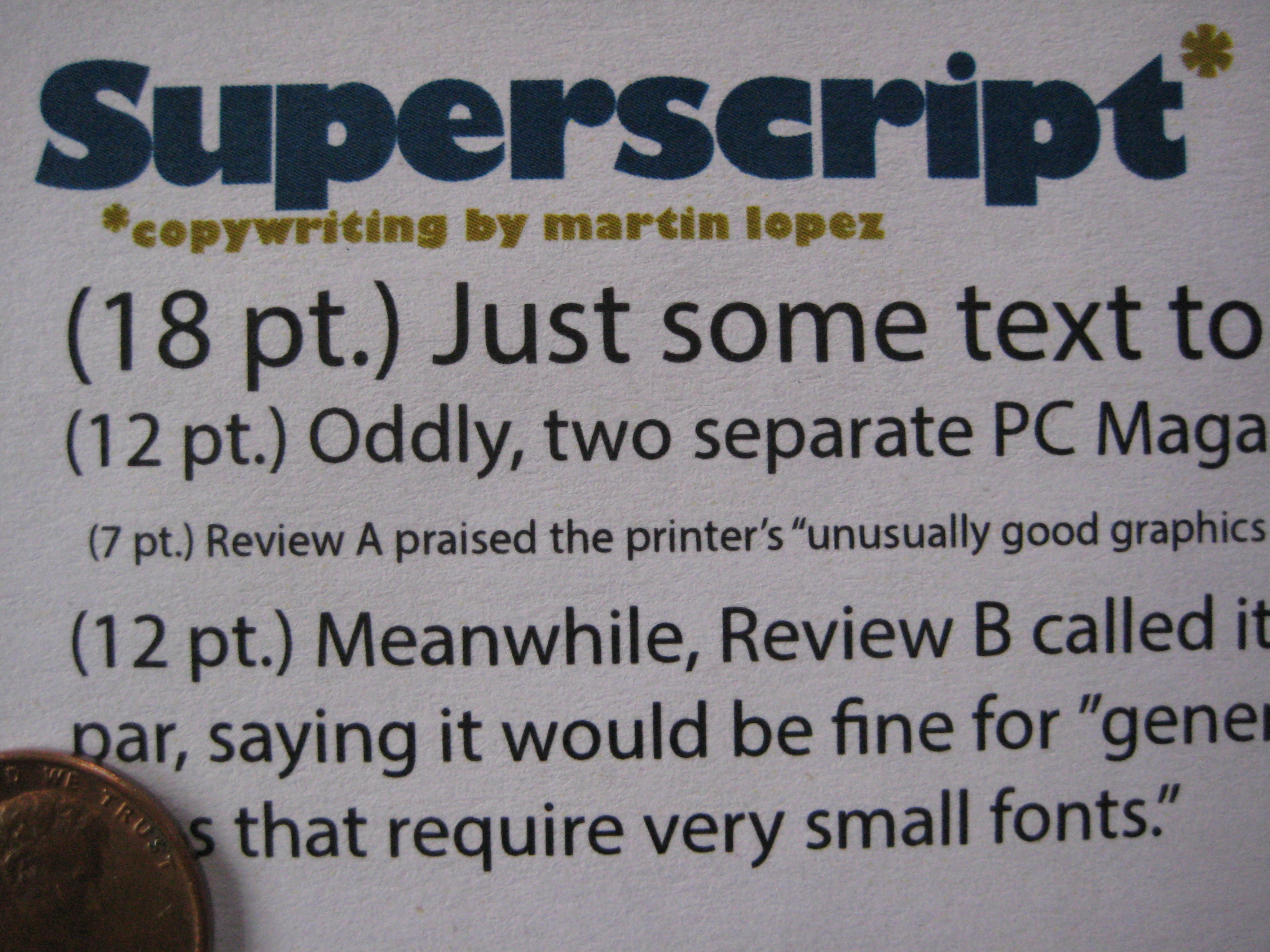
The photo above shows the excellent quality of the printer’s text output.  Oddly, two separate PC Magazine reviews of this printer clashed in their assessments of the printer’s text quality.  Review A praised the “unusually good graphics quality” and called its text output “outstandingly sharp.”  But Review B was lukewarm, calling it “a touch below par,” further specifying the text output to be fine for “general business use, though not for uses requiring very small fonts.”  As you can see in my photo, text looks great in even 7-pt. font size.

Good show, Dell!