Favorite Clients from My First Small Business

Entrepreneurship, Media

Image

While running my rental studio, Silver Street Studio in Houston, it was exciting to work with photographers and agencies of international renown, like Mary Ellen Mark and Mark Seliger, Art Department and Greenhouse Reps.  But it was a special pleasure to work with those photographers and crews that were at bottom simply great human beings.

TONY D’ORIO PHOTOGRAPHY

I think immediately of Tony D’Orio, of Altoids fame.  (Note:  Tony’s photo used in the ad above was not shot in my studio).  How refreshing that, in a profession so rife with jealously guarded tricks of the trade, Tony instead offered a broad openness and generousness of spirit.  Over the course of a two-day shoot for McDonalds, he showed me a couple of studio equipment hacks that made my job easier and that would be enjoyed by other photographers in my studio for years to come.  For instance, he showed me how to switch out the hand-crank machine clamp of an Elinchrom Octabank–which have infamously weak grip—with the more robust clamp from a Matthews C-stand.

http://www.tonydorio.com/

FULTON DAVENPORT, PWL STUDIO

Image

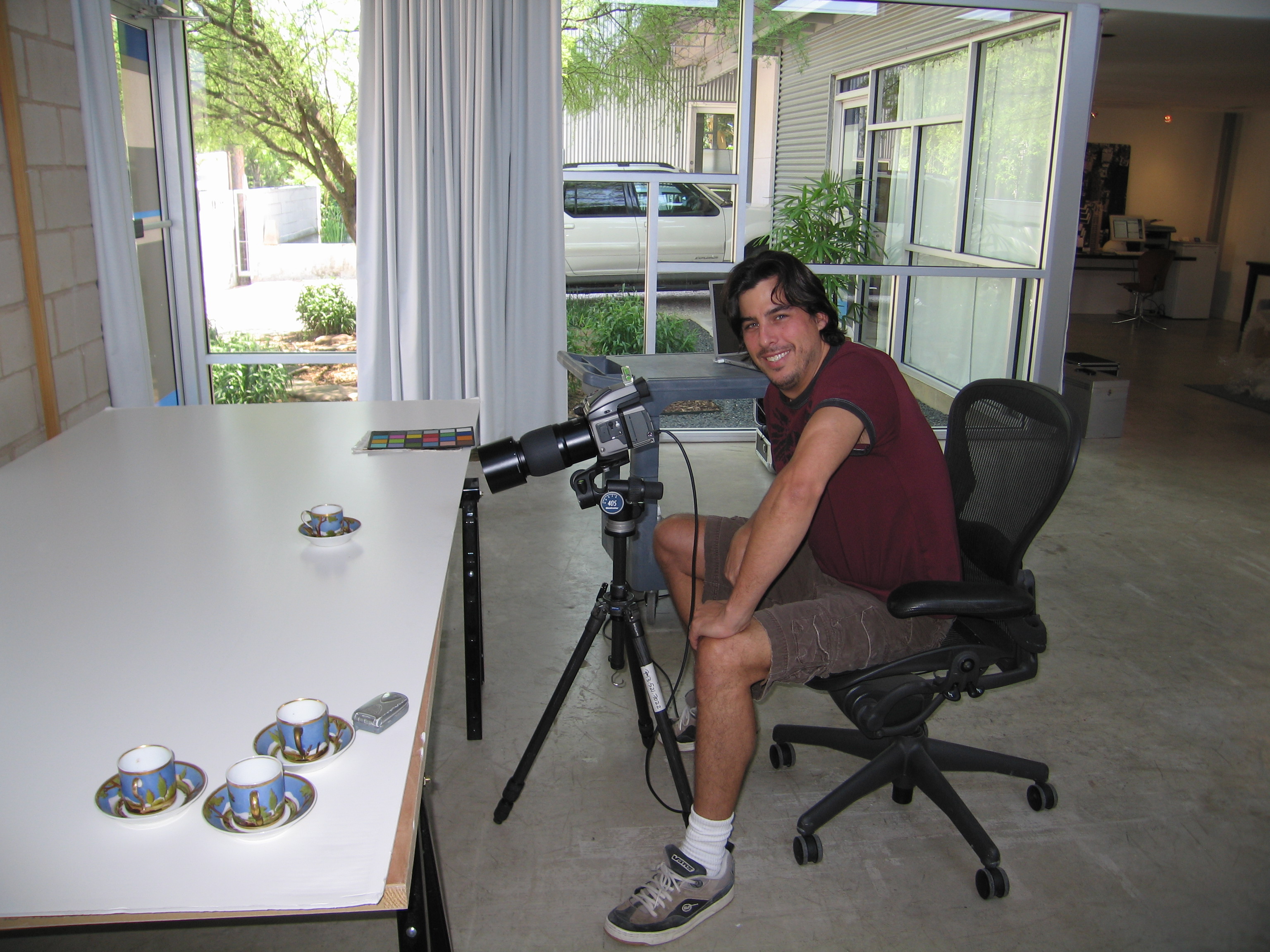
Lucky for me I like photographer Fulton Davenport as much as I do since he was perhaps our biggest repeat client over the years.  With his busy creative firm, PWL Studio, Fulton was shooting in our space practically every other week for years.  One of his specialties is product photography, which was also a specialty of ours.  Take a look at the photo above, of Fulton at work for a high-end antique shop client.  The tabletop set is comprised of expendables and hardware we kept in stock and offered at no extra charge.  Even more to the point of product photography was our studio’s unsurpassed natural light.  Heres Fulton on shooting day light in our space:

“I love the highly technical work, like photographing objects with intense detail, a la Irving Penn shooting for Saks Fifth Avenue.  You’d normally need (or have to build) a light tent.   But here, you’ve got such huge windows on north and south, the light is perfect.  Tents are used just to simulate this.”

http://www.pwlstudio.com/

JUSTIN CALHOUN PHOTOGRAPHY

Imageastronaut mailer sofa guy

One of my favorite people, photographers or not, is Justin Calhoun.  Justin brought us a big job one summer, and one could tell how much the crew liked working for him.  The makeup department, the photo assistants, even the kraft service people were obviously inspired to work hard for Justin, with smiles all around.  What you see here in the two photos above is a Polaroid test shot (the client wanted Justin to shoot film, not digital) and one of the direct mail pieces ultimately produced from the images.

http://www.justincalhoun.com/

FELIX SANCHEZ PHOTOGRAPHY

Image

Another of our busy-busy clients was Felix Sanchez.  Felix was one of the first to shoot in our studio in the early days, and he continued to bring interesting jobs into our space over the next seven years.  (He has his own beautiful new studio now.)  Before becoming a photographer Felix played in a touring Tejano band, so naturally he’s photographed many musicians throughout his career.  Early on with us, Felix was kind enough to help me assimilate the vast expanse that is studio equipment.  He’d report on all of his new experiences experimenting with lighting equipment.  I based many of my equipment acquisitions on Felix’s information.  The job in the photo above was for Walmart, for which Felix transformed our cold, empty space into a warm and cozy living room.  Go check out his handsome new website.

http://www.felixsanchez.com/

Prepaid Wireless: How to Save $800 This Year

Entrepreneurship, Media

phablet

Entrepreneurs are always looking for ways to economize.  I’ve recently found prepaid wireless to be a great source of savings.

A few months ago I left Verizon for Virgin Mobile, and I couldn’t be happier.  I was lucky a friend had persuaded me to give it a try.  Before then, prepaid mobile service wasn’t on my radar, at all.  Why is that?

For one thing, there’s the stigma.  I’d always thought of the prepaid market as being for the credit-challenged among us.  This understanding was accurate at one point.  Prepaid cell service began as a way for someone with bad credit or no credit to essentially put down a “deposit” (hence, pre-paying for service).  By contrast, if you were middle class and credit worthy, the major carriers trusted you enough to give you service and take your payment at month’s end (aka, “post-paid”), even gave you a free phone.  It’s a little-recognized symbol of socioeconomic status.  Even more to the point of stigma:  prepaid phone cards and disposable “burner” phones purchased in convenience stores were associated with drug dealers who needed untraceable hardware for illicit communications.

There is admittedly a somewhat sketchy feel to using prepaid service.  My experience is with Virgin Mobile (VM), but I imagine this applies to most of the prepaid sector.  VM clearly insulates itself behind the Internet, encouraging all customer contact to happen through their website.  And even on the website, there is no traditional “bill”– no “statement”, no calls log, and most importantly, no account number.  If you’re able to figure out how to get an actual human being on the phone at Virgin Mobile, you’ll find them seriously cagey upon you requesting your account number.  Ask them for your account number, and they ask you why you want it.  I guess most customers seek their account number when they’re jumping ship to another carrier (you need it to port your number to another carrier).  For my part, I wanted my account number to set up VM as a “payee” at my bank to schedule automatic monthly payments.  Guess what?  Virgin Mobile doesn’t deal with banks.  They only accept credit / debit cards or “Top Up” cards purchased at drugstores and big-box retailers.  They do not accept paper checks.  Nor can you register a bank account with them for electronic payments.  (Not that I would ever do that, but since when does a company not want your bank account info?)

So what convinced me to try them?

How about saving $70 every month?  Yep, my Verizon bill was $107 each month.  I’m now paying only $37 a month to Virgin Mobile.  Sure, this is for only 300 minutes.  But $107 only got me 450 minutes from Verizon.  And with VM I get unlimited texting and data.  My $107 with Verizon only gave me 4 gigs of data.

The unlimited data has been a big plus.  I now get to watch Netflix on my phone anytime I want, without worrying about my data plan.  With Verizon, that 4 gigs of data was good for only about eight episodes of “Breaking Bad.”  One caveat for heavy data users:   there have been reports of data “throttling”.  I have yet to experience this, but I’m actually not that heavy of a data user.

How do I manage with only 300 minutes on my plan?  The same way I managed with only 450 minutes on my Verizon plan:  I make most of my calls via the Internet.  I use an inexpensive ($5 one-time purchase) VoIP app called GrooveIP.  GrooveIP uses Google Voice to make and receive free calls over the Internet.  It works best over Wi-Fi and 4G, and it does work well enough over 3G, as well.  VoIP setup is somewhat complicated, but here’s how:  http://www.addictivetips.com/mobile/make-free-wi-fi-voip-voice-calls-with-android-guide/

I’ve definitely encountered some drawbacks.  Make special note of this one — although there are a number of BYOD (bring your own device) prepaid carriers, Virgin Mobile isn’t one of them.  You have to buy a Virgin Mobile phone, whose offerings are somewhat limited.  Better than in the past (they carry iPhones, now).  But still limited.  There’s no contract, so there’s no discount on any of the phones.  So I limited myself to a $200 phone budget.  I chose the Samsung Galaxy Reverb.

The Reverb was VM’s top-of-the-line smart phone a year ago (now $130).  It sports a great feature set; by comparison, my Verizon phone was the vaunted Motorola Razr, and the Reverb has every feature I ever used on my Razr.  But, like so many of the lower-cost Android phones, the Reverb has only 2 gigs of RAM memory, and this is the source of my one regret:  with such limited RAM, my Reverb slowed to a crawl once I loaded it up with apps.  Why not install the apps on the external SD card?  Current versions of android (all versions since Froyo 2.2) have allowed users to move apps from internal memory to the external SD card.  The only problem here is, in order for this work, the developer of the app must enable the app to run from the external SD card.  Most app developers have not taken the time to do this.

But, wait, there’s a solution.  It takes some doing.  And customer service certainly doesn’t endorse this since it is essentially a hack.  But here’s how to move almost any app to your external SD card:  http://www.bongizmo.com/blog/moving-all-android-apps-to-sdcard-apps2sd-froyo/  It’s worked great for me.  Now my phone has regained its zip and pizzazz.

So despite some drawbacks, if you’re pretty handy with cell phone configuration, and you don’t rely much on mobile carrier customer service, then going prepaid is not only doable.  It’s great.  What’s not great about saving $840 every year?

(PS:  What does the photo above have to do with prepaid wireless?  Not a thing.  I just think it’s hilarious to see people talking on phablets.)

Beer Roundup #3: Three Midwest Winter Seasonals

Food and Drink

Image

THREE MIDWEST WINTER SEASONALS

Just a word about the scale of my ratings.  I use the weighted average scoring system developed by Beer Advocate, http://beeradvocate.com/help/index?topic=reviewing_beers .  Also, here’s how I translate my numeric ratings into actionable intelligence.

To Buy or Not to Buy?

1 = horrible
2 = bad
3 = average (many better beers out there, won’t buy this again)
4 = very good
4.5 = great
5 = rare best

New Glarus Thumbprint Winter Warmer

Rating:  4.25/5

Pours an orangey-copper into a tulip glass.  Two fingers of light white rocky head that soon breaks down, showing a faint haze.

The aroma is a bit tame.  Raisin and brown sugar, with wood and grass and metal barrel.

Momentarily sweet on the front end, but only for an instant.  Mild hop bitterness accompanies the sweetness through to the throat.  A little smoke.  Sugary dried fruit of the fruitcake variety, think maraschino cherry and fig.  The grassy hops ride the significant carbonation up into the sinuses.  No sign of the 9% alcohol anywhere.

Wish this had more body, though the refreshing carbonation has its own appeal.  Finishes super dry.

If you’re looking for a syrupy/spicy sweet winter warmer, look elsewhere.  This is all imperial Scotch Ale.  Yet a very New Glarus take on the Scotch Ale–crisp and refreshing, fruity, earthy, with a bit of hop bite and sharp mouthfeel that dries the style.  Oh, man, as it warms, it drifts deliciously closer to the center of the Scotch Ale tradition.

Alaskan Winter Ale, Alaskan Brewing Co.

Rating:  4.25/5

Had this as a 10 oz. chaser to an exceptional Bloody Mary at The Caribou (Madison).  Bright amber, with a small white head and serious lacing.

Knowing Alaskan for the syrupy greatness that is their Pilot Series barley wine, I predicted this winter warmer would have a sugary persona.  Boy, howdy. Low in alcohol (6.4% abv) for what I’m used to in old ales, the aroma is quite mild, more like an amber ale, without much by way of spice or hops.  Definitely bready and nutty, to be sure, just a bit quiet in the nose.

Surprisingly thick and creamy in body.  High sugar content sweetness, even for an old ale, without the leather or sand of others in the style, like North Coast Old Stock or Founders Curmudgeon, which I’m glad for.  Surprising sugar-citrus, sweet-ripe mandarin orange.  I’d say apricot, green grape, too.  Wasn’t expecting all the fruit.  No hops to speak of, though the sweetness comes in balance, so there must be some bitterness.

Totally satisfying, though doesn’t touch the outer realms of my favorite old ale, Bells Third Coast Olde Ale (arguably more of a barley wine, anyway).

Bells Winter White Ale

Rating:  4.14/5

Somewhat unfair to be drinking this after my favorite witbier of all time, Hitachino Nest White Ale. But what are you gonna do?

Pours a Hazy straw color, with a lemon juice look to it.  Fast-dissipating white head with fluffy bubbles.

An aroma instantly recognizable for the style, it’s spicy and yeasty in the nose, with some wet cardboard.  Green grapes, other indeterminate fresh fruits, maybe pear, maybe melon.

On the tongue it’s grass and white pepper, first. Coriander, awesome winter spice profile.

Eminently refreshing, yet with seasonal fruits, including tart apple and a hint of banana.  I like the spices, which are admittedly on the subtle side.  Plus the wheat and yeast of Belgian whites that come off as comforting old patterns.

Moderate carbonation keeps everything bright and sharp.

Have I mentioned how refreshing this is?  The complexity is all in the fruits, which may sadly overpower the spice.  Not quite on par with Allagash White, but close.

THE WRITER vs. THE AUDIENCE: THOUGHTS ON NANA (anime)

Media, Writing

ImageSorry its been a while since my last post.  Ive been busy working on a short story.  I thought I might post some of it here, but I’m lucky I didn’t:  I’ve just learned that doing so would disqualify the story from being published in any journal that asks for first-publication rights, which is pretty much all of them.

THE WRITER vs. THE AUDIENCE:  THOUGHTS ON NANA (anime)

What am I, a child?

I’m watching the addictive anime series NANA, and I’m totally shocked with the turn the story has taken in ep. 16.  The episode begins with Nana’s/Hachi’s breakup with Shoji, which ought to have been the saddest, heaviest weight on the series, good for at least one or two whole episodes of delicious self-pity and navel-gazing.  But before the episode ends, we see the writers have dumped it instead for the intrigue and potential reunion of Nana and Ren.

I’m totally impressed with the provocation and propulsion of this unexpected, whiplash plot shift.  What’s even more impressive, though, is that the writers have gone against the grain here.  What I, and I suspect most of the audience, really wanted was more time for Hachi to grieve her breakup with Shoji.  But the writers decision to defuse the explosion of the breakup was the right choice, even though it goes against the audience’s wishes.

How could that be?  Aren’t writers bound by the pop-cultural imperative to “give the people what they want”?  How have they gone against this maxim without alienating the audience?

They’ve done it with character.  To move the plot in the direction of Nana + Ren, i.e., away from Hachi’s troubles, is a character-based move.  First of all, it’s a distraction, or a move of self-preservation.  Hachi’s situation is grave:  Shoji was her entire reason for moving to the big city, and he has dumped her.  Without Shoji, there’s nothing keeping her tethered.  She hates her job (which is as menial and dead-end as jobs get) and is on the verge of being fired from it.  She has also nearly estranged Nana, the only solid thing she has left.  In short, she’s on the verge of having to leave Tokyo, her dream of being a big-city girl in ruins.

Rather than facing down her troubles, she lets herself be distracted.  We know she’s a match-making schemer, so naturally she becomes obsessed with reuniting Nana and Ren.  She’s also a sucker for two birds, one stone opportunities.  Bird 1:  recouping her image in the eyes of Nana.  Bird 2:  forgetting how close to loneliness and financial desolation she has come.  In other words, it is a character-based move for the plot to take this turn.  It’s built into Hachi’s DNA.

(Side note:  even when it seems all the focus is on Nana, more than ever it is Hachi that’s steering this ship.)

At first I was disappointed with this plot twist.  I felt cheated.  I wanted more time to wallow in the gloom and self-loathing of Hachi finding Shoji with another woman.  It’s only in all this meta talk that I’m able to appreciate what the writers have achieved.  What they’ve given us is better than what I wanted.  Far better.  To wallow in the basest of emotions–it’s not unlike giving over to feelings of bigotry or directionless rage.  I thank the series writers for rescuing me from a downward spiral of weepy, woe-is-me bitterness.

But who could blame us for wanting self-indulgence?   It makes sense that people are addicted to melodrama.   On the one hand, it’s what a child would choose.  But on the other hand, we were all once children.  Picture me at six years old, walking home one morning after a sleepover, carrying a paper plate of cookies I’d helped bake the night before.  The plate folds and the cookies fall to the street.  Rather than pick up the several unbroken ones (i.e., counting losses and moving on), I weep bitterly for my loss and stamp them into the pavement.  I run the rest of the way home shrieking bloody murder.  At home in the kitchen with my parents, I’m inconsolable.  I say, I’ll never bake cookies again, never.  

It’s not about the lost cookies.   It’s about the caretaking I evoked by coming home a blubbery mess.  It felt good to have my parents cooing at me and petting my hair.  And I knew by instinct the melodrama I’d brought home would elicit that response from them.

Children are drama queens.  So are adults, when not on guard against it.  And when you’re watching a riveting dramatic series, you’re not on guard against anything.

What the audience would have chosen is vastly inferior to what the writers gave us.  Choosing self-pity — that would’ve been choosing the irrational, choosing stasis over progress.

In other words, it wouldn’t advance the story.  And if there’s one maxim that trumps giving the people what they want it is this:  The story must advance.  Anyone who has watched a great TV drama knows why this is.  There’s just too much story to tell.  The writers have no time to waste.

The writer knows this.  Good thing it’s the writer in charge of the script, not the audience.

In Defense of Miyazaki: Thoughts on WHISPER OF THE HEART

Media, Writing

Image

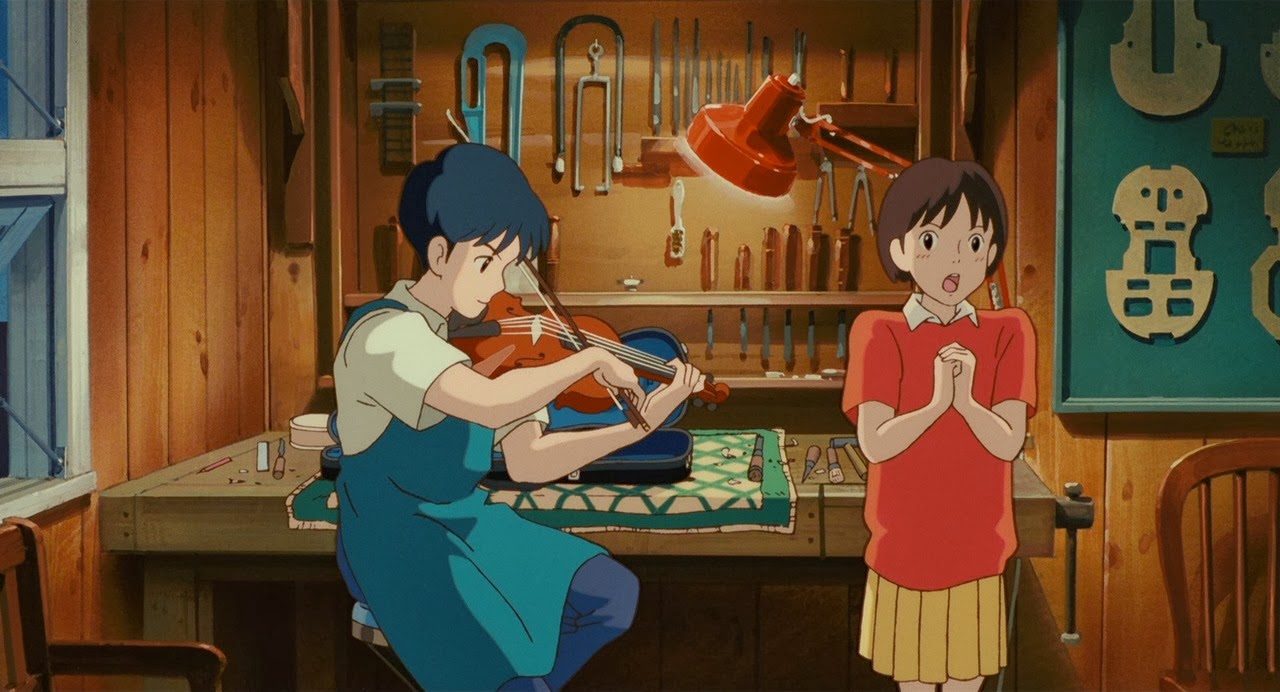
I used to pooh-pooh the films of Hayao Miyazaki.  Back then I’d acknowledge them as technically brilliant, or that they were true achievements of cinematic vision.  But I used to feel they were soft, over-optimistic, naive, or lacking the grit and edge of realism.  By contrast, my touchstone for anime has always been Mamoru Oshii, of Ghost in the Shell fame.  Oshii says of Miyazaki, “His worlds have become just too nostalgic”, and, “[I]t is joyful, it’s eye candy and it is a pleasure to watch his movies, of course.  But . . . people don’t die [in his scenes of military battle, for example], so they are nice to watch but there is no realism”.

I’m usually right there chiming in with the naysayers about Miyazaki films (Howl’s Moving Castle, Spirited Away, Princess Mononoke, Nausicaa…), that Miyazaki is the Disney of anime (or at least the Steven Spielberg, with all the predictably happy endings).  To begin with, I’m much more partial to anime stories of psychoanalytic self-loathing.  Filling out my Top 10 list are the self-hating anti-heroes of Neon Genesis Evangalion, Trigun, Cowboy Bebop, Ghost in the Shell II:  Innocence, and Barefoot Gen.

But all the while there have been exceptions to my rule.  I’ve fallen in love with anime that most Oshii fans would call sappy or sentimental, mushy or maudlin:  Fruits Basket, FLCL, Castle of Cagliostro, Please Save My Earth, Macross (Super Dimensional Fortress Macross),  Escaflowne, and The Girl Who Leapt Through Time.  Some of these can be explained as “not inconsistent” by way of them being mad-cap, slapstick comedy, like Castle of Cagliostro, FLCL, and perhaps Macross.   But how do I explain all the dew-eyed idealism?

Am I going soft?  No, that can’t be it, not with apocalypse and earth-under-attack plots figuring so largely in all of them.  And it’s absolutely not the case that I’m merely lowering my standards of intellectual and conceptual challenge; I value these works so highly that I no longer talk about my “Top 10”, I now always name my Top 15 when discussing my favorites of all time.  So how does an otherwise orthodox Oshii fan like myself remain consistent and still keep The Girl Who Leapt Through Time on his Top List?

Although the film Whisper of the Heart does not make my Top 15, briefly discussing it here could go far in answering these questions.  Written by Miyazaki and produced at his Studio Ghibli, Whisper of the Heart (WOTH) features all the schmaltz of a Miyazaki film:  child protagonists and first love, idealism and nostalgia.  (The film recasts the musical juggernaut of nostalgia “Country Roads” into Japanese, changing the title phrase to “Concrete Roads” for the setting of suburban Tokyo.)  But unlike Miyazaki’s more famous films, WOTH is not a romanticized coming-of-age fantasy in which the protagonist must save the world.  Its hero is merely an adolescent suburban girl trying to find herself, while reacting to the attentions of her first suitor.

What might seem fantastic is the uber-traditional nature of her search for identity–especially in a time (1995) of white-hot digital media and ever more sophisticated sci-fi visions coming out of Tokyo near the end of the millennium.  Our girl hero is seemingly transported back to a more traditional time not by a time machine, but by her love of reading fiction (in actual books!) and by falling in love with a boy rooted in tradition by his folk music family and his craftsman aspirations.  (He’s apprenticing to be a violin maker.)  In other words, our hero’s search for identity takes place in the realm of the arts.

Sure, the film ends with the boy declaring his love for the girl.  But what really matters–the more important conflict–is the girl’s decision to become a writer.  It’s true that, in the closing sequence, our hero’s love interest takes her to see his secret Tokyo sunrise and not only declares his love for her from the proverbial mountaintop, but he also proposes marriage.

Sappy enough?  Yes, but only for a moment.  In the next instant you realize two critical things:  a) that these kids are only fourteen years old, and, b) that the boy is shipping off to Italy for ten years that very afternoon.  The marriage proposal in the final sequence has a stuck-on feel.  It seems to come from out of the blue.  And one realizes this is pointedly artificial.  While romantic stories commonly end in marriage, this one ends with a marriage proposal, only.  It’s sweet and optimistic.  But it’s not marriage.  What’s next (off-stage) is that the boy will immediately leave for Italy, to stay for ten years.  So one has to wonder about this premature engagement;  a lot will happen in ten years.  And this is the point:  while love and marriage may still be fantasies for this particular hero, what her heart is whispering to her is a realism common to all the anime in my Top 15.  This is not the story of the birth of young love, but, rather, another story entirely:  the birth of the artist.

How Breaking Bad Teaches Us to Watch Great Drama

Media, Writing

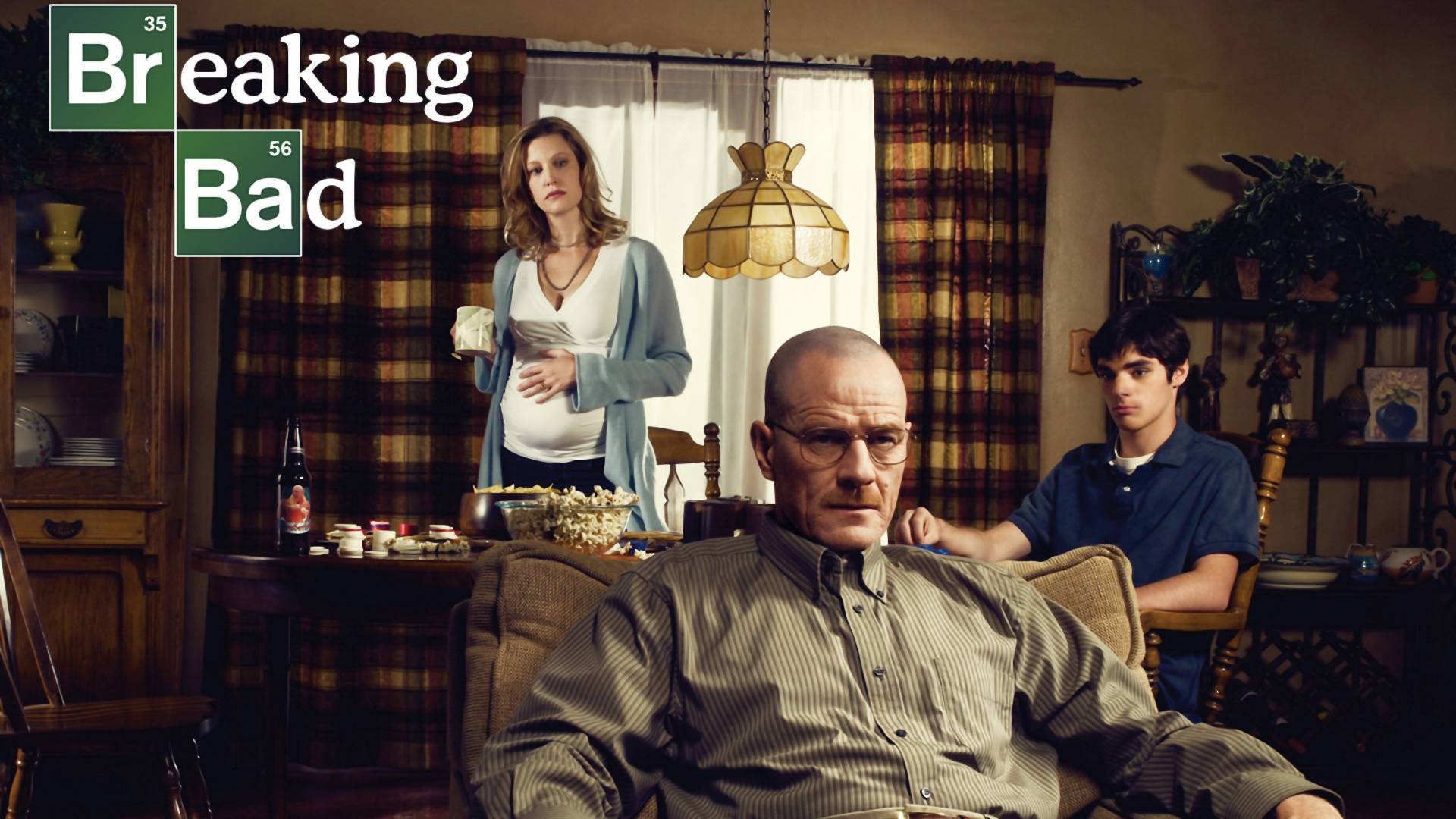
breaking badI come to the party a bit late, having been busy re-watching a string of other brutally intelligent series:  Dollhouse, Deadwood, Madmen, Ghost in the Shell S.A.C. 2nd GIG.  But I’m finally digging into Breaking Bad, and it’s plain to see what all the fuss is about.

As any good storyteller does, Breaking Bad teaches you how to watch.  For instance (spoiler alert!) in the intro to Episode 6, Season 1, Walt gives a speech to his partner in crime in which he agrees to continue manufacturing methamphetamine but only according to a set of limits and boundaries, chief of which is the declaration that there be “no more bloodshed”, a reference to the two rival drug dealers they’d killed in Episodes 1 through 5.  Interspersed throughout this speech are edits that cut away in piecemeal fashion to some other scene, a scene of some kind of street violence involving an exploding building and someone leaving the scene of the explosion with what appears to be a severed head in a bloody canvas sack.  You ultimately realize the cutaway scene is from the end of the episode and that Walt has blown up the building and has likely killed a man.  And this time, by the look on Walt’s face, it appears the murder has been committed with malice, perhaps a revenge killing.

This totally works in the show’s favor.  The sequence follows the conceit of the series structural design that was set up in the intro to Episode 1.   In the intro to Episode 1, in medias res, we’re given the show’s hero speaking hastily into a handy cam, as police sirens approach in the distance.  Speaking into the camcorder Walt is addressing his wife and son, asking their forgiveness for unstated crimes which he has committed in the name of providing a future for his family, while in the background we can see an RV containing the dead bodies of two rival drug dealers.  In other words, each episode’s intro gives us a teaser:  a peek ahead to Act III of the episode’s classic three-act structure.  This creates narrative drive:  the audience is then driven to watch Acts I and II to find out how the hero has landed himself in such deep trouble.

In three-act structure, according to Star Wars producer Gary Kurtz, “[I]n the first act of a story you put your character up in a tree and the second act you set the tree on fire and then in the third you get him down.”  Breaking Bad’s innovation is to give us a peek at Act III in the intro to each episode.

After the opening credits, Act I of nearly every episode show us mild-mannered Walt White, high school chemistry teacher, whose admirable middle-class values and underdog status make him an anti-hero the audience can identify with.  Act 1 of each episode starts with Walt behaving or speaking sanely, the emotional floor steady and level beneath the audience.  In Episode 1 specifically, this is pre-cancer Walt.  As his health (including his mental health) is destroyed by cancer, his middle-class world view is also wrecked, annihilated, even.  Into the moral vacuum rushes the alternate Walt, who, upon learning the cancer will soon kill him, decides to become a drug dealer.  In other words Act I ends by answering the why–why Walt turns to a life of crime.

Act II answers the how–how it comes about that Walt not only manufactures crystal meth, but in the process also kills people.  In Act II Walt not surprisingly is confronted by a savage harvest of physical threats, moral dilemmas, and golden opportunities born of his choices and of the exigencies of the street.  Even more to the point, though, Act II amps up Walt’s underdog resentment of the broken world.  His public-school teacher salary being what it is, Walt is forced to take a part-time job once his wife becomes too pregnant to work.  After school he hustles to a nearby car wash and works as its cashier, where his mild manner is abused by an unreasonable manager who orders Walt outside to wipe down wet cars when a line employee calls in sick.  One of the cars is the gleaming new Corvette of a rich kid who earlier in the episode is seen disrespecting Walt in the classroom.  The rich kid humiliates Walt by photographing him stooping over with a dirty rag and texting the photo to others.

Such telling detail instructs the audience in how to read the show’s themes, while also pumping up the tension by fully earning each episode’s extremes of character development and drama.  Why does Walt do what he does?  I’ll tell you why! the screenwriters say.  In grad school, one of my MFA professors called this the GRAB principle:  Give the Reader a Break–never leave the audience confused as to why protagonists do what they do.

In Episode 6, we see Walt in the classroom lecturing about chemical reactions.  He says at one point, “Chemical reactions that happen slowly change very little, so little we hardly even notice the change, like rust forming on the underside of a car.”  Walt pauses mid-sentence, frowning at what he’s just said, and of course we are put in mind of Walt’s cancer.  He continues his lecture.  “…But, if a reaction happens quickly, otherwise harmless substances can . . . generate enormous bursts of energy . . . as in explosions, [and] the faster they undergo change, the more violent the explosion.”  We think of the whiplash pace with which Walt has shed his middle-class skin and become a local methamphetamine kingpin on the DEA’s most-wanted list.

This also hints at the violent reaction taking place in the hearts of the audience.  Like seeing one’s reflection in the glass pane of a disturbing framed work of art, we viewers are implicated in Walt’s man-slaughtering ways by virtue of sympathizing with him.  Isn’t it common, after watching an episode, to later in the day walk around with the guarding sensations of dread and suspicion?

Beer Roundup #2: Three from New Glarus

Food and Drink

beer black top

THREE FROM NEW GLARUS

Just a word about the scale of my ratings.  I use the weighted average scoring system developed by Beer Advocate, http://beeradvocate.com/help/index?topic=reviewing_beers . Also, here’s how I translate my numeric ratings into actionable intelligence.

To Buy or Not to Buy?

1 = horrible
2 = bad
3 = average (many better beers out there, won’t buy this again)
4 = very good
4.5 = great
5 = rare best

I come to the New Glarus party a bit late. All this time I’ve labored under the misconception that New Glarus is a one trick pony, albeit the best in the country at their single trick (fruit beers). All this time I’ve pooh-poohed the several NG non-fruit beers that I tried early on, Spotted Cow, Fat Squirrel, Two Women Lager, Staghorn Oktoberfest. I’ve heard people defend these four beers as “true to style”, or that New Glarus has developed a following of both beer geeks and mainstreamers alike, and that that is no mean feat. And sure, their “Thumbprint” small-batch series has produced some very serious one-off brews (Anniversary Strong Ale; a very good barley wine).

Not until last month, at the urging of a friend whose beer vision I trust, did I come to these three NG brews below, all astonishing in their intense, complex flavor (i.e., without merely dry-hopping our heads off), and, what I find most impressive, doing so at low alcohol (just 5% – 5.3% abv in Moon Man and Stone Soup).

Black Top IBA, New Glarus Brewing
Rating:  4.34/5

Pours brown-tinged black from a bottle into a tasting snifter, with a khaki finger of head. Aleutian islands of lace stick permanently to the glass.

Surprise: an aroma of summer citrus fills the nose. With IBA (imperial black ale) in its name, the near-opaque abyss had me expecting roastiness. But there’s none, zero. No malt or grain or bread in the aroma at all. Maybe the slightest vague caro-syrup sweetness. The aroma is basically American IPA.

Flavor in the mouth is a shock of sweetness on the front of the tongue–the khaki froth itself is candy-sweet. Then of course the flavors of American IPA slide in and take hold with assertive hops. The profile fades into a molasses back-end. It’s all perfect, balanced, hop bitterness and bready sweetness.

This beer has cracked my top-five non-big-beer beers of all time.
—-
UPDATE: I’m revising my review after having tried another stellar IBA, Radio Free IBA, by Lake Louie Brewing. I totally loved Black Top when by itself. But next to Radio Free IBA, my malt-lover preferences assert themselves, and I have to downgrade Black Top from 4.58 to 4.34.

Also, Black Top seems to fight with a lot of different foods.

Still, amazingly flavorful, while remaining eminently refreshing.

Moon Man APA, New Glarus Brewing
Rating:  4.26/5

I’m totally amazed at this. Incredibly refreshing, yet with massive flavor for an American Pale Ale. It goes with more food than most beers, so bring it to a dinner party with confidence.

A beautiful pour into a goblet, an orangish-straw color with an amber refracting clarity, and, most of all, lacing with real stick-to-it-iveness.

Intensely pleasing aroma of grapes, honey, bread, et al.

Flavor in the mouth is kind of all over the place, but in the best way. There’s tropical fruit, sweet muffin, and bright-mild floral bitterness. Then more sweetness in the throat, Florida orange, ripe tomato, and faint shades of white gumball.

This has nearly cracked my Top 5 non-big-beers of all time, including Hitachino Nest While Ale, Saison de Lente, New Belgium La Folie, Rodenbach Grand Cru, and Monks Cafe Flemish Sour.

Update:
I don’t know what’s up with my taste buds, but I’ve got to downgrade this beer from 4.43 to 4.26. It’s still an exceptional small beer. But now that I’ve had the greatness of NG Stone Soup (see below), Moon Man pales somewhat.

Stone Soup, Belgian Pale Ale, New Glarus brewing
Rating:  4.44/5

Pours a viscous gold, with a huge fluffy white head that goes nowhere.

Sweet honey and malt in the aroma, with banana and pear.

First, two sweetnesses greet the tongue, honey and banana taffy.  The significant carbonation keeps it well away from cloying territory (unlike other lesser BPA’s, like Leffe Blonde, or Petrus Blond).  There’s then a flash of mild hop bitterness, white pepper, and lemon zest.

Incredibly crisp and light, while impressing with full-ish flavor. At first, because I’m more used to bigger Belgians (dubbels, tripels, and quads), I experience a confusing lack of body and phenols.  Once Im over that confusion, I like this a lot, the way I like Fatty Boombalatty, by Furthermore Brewing

Overall, this is the closest to the real deal that an American Belgian-style “single” can be, as opposed to weaker pretenders, like New Belgium 1554, or, egads, Blue Moon Abbey.  It also goes with most any foods.  This will hold a regular place in my fridge.

Beer Roundup #1: THREE RUSSIAN IMPERIAL STOUTS

Food and Drink

beer expedition landscape

THREE RUSSIAN IMPERIAL STOUTS

Just a word about the scale of my ratings.  I use the weighted average scoring system developed by Beer Advocate, http://beeradvocate.com/help/index?topic=reviewing_beers . Also, here’s how I translate my numeric ratings into actionable intelligence.

To Buy or Not to Buy?

1 = horrible
2 = bad
3 = average (many better beers out there, won’t buy this again)
4 = very good
4.5 = great
5 = rare best

Bells Expedition Stout

Rating:  4.49/5

look: 4.25 | smell: 4 | taste: 4.5 | feel: 5 | overall: 4.75

I seriously have to upgrade my previous 3.75 rating from last summer. Perhaps that bottle at the Come Back In (Madison) last June was oxidized. Even more likely, I simply drank it too cold, without a glass, and distracted by the Come Back’s legendary karaoke scene. Whatever the case, the specimen I’m now this moment holding in my hand is fabulous.

A fairly aggressive pour into a tulip glass gives a small head, w/ almost no lacing, the slippery solvent alcohol refracting on the glass.

The aroma is still remarkably tame, though subtly rich with burnt coffee, uncooked pasta,  maybe caramel, and faint woody alcohol.  And a bit of leather (but in a good way; I normally detest leather in beer).  There’s undoubtedly a quiet majesty, here, just a bit too quiet.

The flavor in the mouth, wow, now that’s a different story.  Incredibly complex. It oscillates between many different dyads of bitter and sweet:  burnt toast and milk chocolate, anise and  toffee, honey-baked ham and oatmeal-raisin. Wait, that last pair are both sweet. Plus an alcohol heat and an odd salt that help give shape to the mouth-expanding sweetness profile.

A fullish-bodied, slick-viscous texture, like warm maple syrup. Yet that syrup is leavened by a moderate carbonation, even as the pour in this tulip glass has risen to room temperature.

Update: several hours later, I’m getting more aroma, now, from the mouth of the empty bottle. Orange peel, black pepper, black cherry juice, unripe tomato, and dopplebock malt.

Founders Imperial Stout

Rating:  5/5

look: 5 | smell: 5 | taste: 5 | feel: 5 | overall: 5

This one has tipped the scales. It’s cracked my Top-5 list of all-time favorites, of all beer styles.

I should make special note, though, this beer has the unfair advantage of aging.  I somehow found this four-pack at a nearby bottle shop this week.  That means it must be 10 months old; the Founder’s release schedule for “Imperial Stout” is January. How this sat on a Madison store shelf in plain view for nearly a year is beyond me.  Elite beers don’t last long in this town.

One of the blackest beers I’ve seen all year (cf. Dark Horse Reserve Special Black). A chocolate meringue-like brown head chokes the neck of my tulip glass and leaves lacing plastered on the glass.

Dark chocolate and burnt coffee rise in the nose, first. Then a cascade of stone fruit, especially overripe cherry and prune.  Boozy vapor cuts what might have been cloyingly sweet.  There’s also a nice dark bread aroma.

I just the other day had their Founders Porter on tap, and I’m now struck by the same particular roasted coffee flavor in the mouth, here. Except this of course comes with an undergirding of overripe cherry and dried fig to replace the bright/tart hop bitterness of the porter. The massive, corn-syrupy fruit-cake and pecan flavors remind me of Southern Tier Mokha, another of my favorite double stouts. The alcohol politely makes itself known on the backend.

I’m cognizant of the mellowing effect the ten months worth of aging has imparted to this beer.  I had this on tap last spring during Mad Craft Beer Week and, sure, I was impressed, but this, this has rocked my world.

Narwhal, Sierra Nevada Brewing Co.

Rating:  4.26/5

look: 4.5 | smell: 3.75 | taste: 4.25 | feel: 4.75 | overall: 4.5

From a 12 oz. bottle into a tulip glass.  Black.  Oily.  Chewy brown head whose lacing slides off the glass via some obvious alcohol solvency.

Boozy aroma, w/ coffee, barely detectable chocolate.  Nice, but fairly simplistic.

Booze first on the tongue.  Then tart stone fruit, cherry, prune, or is it black plum? Cocoa’s next, along with bitter molasses reduction. Then more booze, which is an issue.

Thick, oily, despite the significant carbonation.

Very much like Old Rasputin, which isn’t my favorite RIS. I like them sweeter than this and with less alcoholic heat. The simplistic aroma is the weak spot, here. And one wishes there were more chocolate and/or vanilla involved. It’s still quite good.  And at this price point ($8.99/4-pack), I’ll drink this regularly.

How Madison Healed an Ailing Entrepreneur

Entrepreneurship, Health

awesome pup(photo credit needed)

Madison has made me whole again.  A phoenix rising from the ashes?  Check.  And not a moment too soon.

I was recovering from a serious loss:  grieving the death of my first beloved small business to the cancer of the Great Recession. Obstructing the grieving process was the insane work schedule of my new small business, a nighthawk radiology service.  Nighthawk radiology is third-shift work, 7 PM to 7 AM, seven days on and seven days off.  Each night my two-man team would process (receive, read, and report on) the ER imaging of 130 patients per night from nine regional hospitals.  Then we’d sleep the day long, eat “breakfast” at 5 PM, and do it all over again.  Needless to say, the intensity and Sysiphian nature of my work week allowed for little reflection or meditation.

But at the end of workday seven, I would fly from Houston to Madison to spend my off-week with my wife, who had just gone back to school for graduate studies in public health at UW Madison.  I was greeted each week by the magical sight of Tenney Park (below; photo credit needed), which is essentially the gateway to Madison coming from the airport.

Tenney Park

We lived in UW married student housing, called Eagle Heights.  Each Monday morning I would have the cab stop short of the complex and let me off at the bottom of the hill for a nice stroll up the bike path (below).

2012-10-18_16-17-55_63

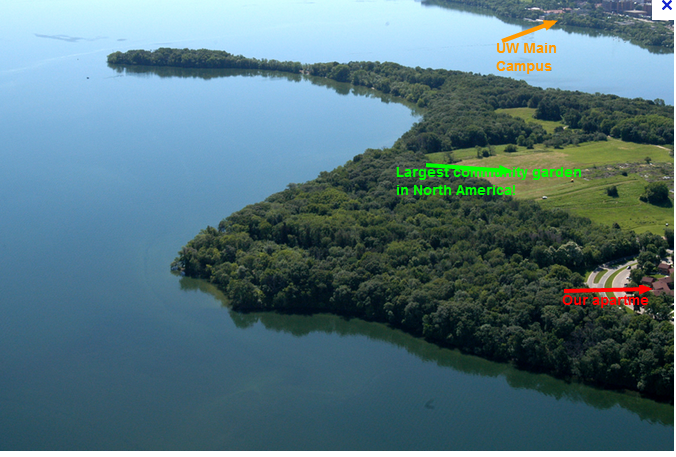
Eagle Heights was a throwback to mid-century institutional community design, with 1200 units housing over 3000 people essentially off in the woods.  It was separated from the main UW campus by a mile-and-a-half of the lake shore, which insulated us from the famously hard-partying undergrads.

It was a quiet hideaway, shaded in summer by 150-foot white pines and old oaks of ten-foot girth.  Summer mornings could get a bit rowdy, as hundreds of the children of grad students ran wild in this bubble of safety and open space.  Summers in Eagle Heights demonstrate the occupation of little kids to be the playtime mimicry of working adults.

eagle heights sandbox

The adults spent a lot of time in the dirt, as well:  Eagle Heights has the largest community garden in the United States (below).
frautschi pointjpg

Our two-bedroom unit was “cozy.” We had brought our king size platform bed with us from Houston, and we were lucky to assemble it with the bedroom door open because, once the platform was screwed together, it blocked the door. Tiny, yes, but the 650 square-feet of space had been laid out so well that we had all we needed.

That tiny apartment, with its single entrance and instantly surveyable floorspace, both swaddled me in warmth and encouraged me to spend time outdoors (which I took to include all the quality beer bars in the area). For us coming from a 3000 ft.² house in Houston, Eagle Heights living forced us to pare back. It was a cleansing consolidation, sorting and culling the piles of material possessions one collects over the years. I was astonished to find myself able to let go, even of items from my childhood that had an irrational hold on me, like this model ship which found a very good home in the bedroom of one of our favorite neighbors (below).
20130525_091620

I feel the emblematic patterns of Middle Life–moving out of state, changing careers, gaining weight, losing hair. Yet I feel it’s in Middle Life that one can make certain choices one couldn’t have made years ago. I feel I’ve traded an old sailing vessel that wasn’t doing me any good for a new one. (Have I mentioned I’ve joined the sailing club?)

29340020

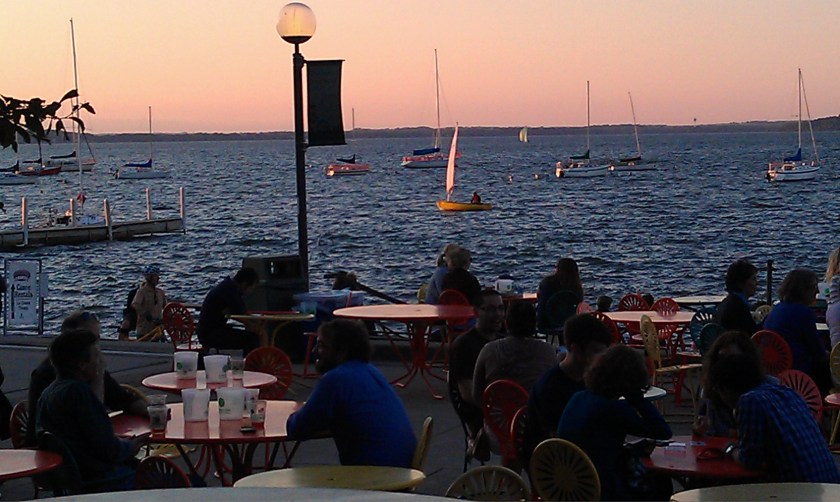
Joining the UW Hoofers sailing club  is something I never would’ve done before.  My pre-Madison worldview was that of consumer first.  And what do good consumers do when they want to go sailing?  They buy a boat of their own.  That probably explains why I’d never chosen to sail:  the concept of owning a boat, and a trailer with which to tow it, and rented storage, all presented a barrier to my entering the world of sailing.  The UW Hoofers Sailing Club leverages the resources of the community to provide the boats and infrastructure and volunteer efforts for maintenance.  For a modest $295/year, I can sail any of the 100+ boats (from dinghies to sloops, on up to six different keel boats), windsurfers, and even snow kites in winter.  Perhaps best of all is unlimited instruction at no extra cost, which is how I learned to sail.
terrace

Speaking of winter, I ride my bike year-round.

ebike snow

In fact, when my wife and I moved to Madison, we sold our cars and left them behind in Texas.  Madison is compact enough, we can go nearly everywhere we want on our bikes.  When we do need to go farther, the Metro bus system is superb, with seemingly more lines than one could ever need.  Also nice, there’s no bus stigma.  To see the bus carrying individuals of many different income levels is to see a city that confronts its traffic problem as adults:  rather than ever-widening streets at the expense of all else, the city actually restricts traffic in various ways, chiefly by restricting parking.  Instead of encouraging more cars into the city center, the city provides great public transit and some of North America’s most admired cycling and pedestrian byways.  The true economic elite in this town still of course drive luxury cars to work every morning.  But if they work in the city center, they park at a premium.  Everyone else enjoys free (with any current student ID) or cheap and highly efficient trips by bus, bike, or on foot.  I recently took the heavily used route #70 nine miles to the west side during rush hour, which took twenty-five minutes.  That same trip on a woefully under-funded bus system in Houston used to take me a punishing 45 minutes each way to and from the college campus where I taught.

Rather than prioritize the individual in his or her own car, Madison coaxes individuals out onto the streets, preserving great public spaces for more people to enjoy.  The site of its lively sidewalk culture and busy bicycle commuter paths could be mistaken for one of the nation’s great cityscapes, like Portland or Seattle or Berkeley.  Madison is a small, compact place.  Competing interests collide.  Hard choices must be made.  It’s clear the city is making many of them well.

aerial_UW_50mm11_1901

There is also Community Car, a car sharing club that rivals the amazing value of the Sailing Club.

CommunityCar logoFor a one time $35 sign up fee, we joined the club and can reserve any of the Priuses, pickup trucks, Honda Fits and Civics, five of them kept in various spots within a mile of our apartment.  The cars are fully insured and fully fueled at no extra cost, save for the hourly fee, which is only $7.50/hour or the $3.75/hour Night Owl rate after 11 PM.  Mileage only costs extra beyond 150 miles in a day.  My wife and I rent Community Car to the tune of $20/month on average. The service hits that sweet spot that’s  triangulated between the bus, the bike, and walking.  The car isn’t the symbol of American individualist freedom for nothing; it can be a real advantage to have a car for certain scenarios.  But not owning a car–not shouldering the financial costs (depreciation, fuel, interest on financing, insurance, sales tax, maintenance, repair; Consumer Reports estimates such costs for a Mini Cooper to be $5,800/year!) or the costs in lost time (dealing with maintenance or breakdowns or flats or dead batteries, researching the purchase, researching the maintenance/repair providers)–now, that’s a freedom in and of itself.  The catchphrase in the Community Car logo is “Own less.  Live more.”  I get that now.

This post is getting way too long.  Besides, by now one can see what I’m getting at about Madison.  Madison has shown us a paradox:  the riches of living modestly but deeply and without fear, in a place that values community.  In this town I feel awake again.  Again?  Or is it really for the first time, ever?